
001
FrankJamison.com:
Front-End Foundations
The 2015 version of FrankJamison.com represents a clear, inspectable moment in the evolution of a developer learning the web by building it directly. This repository captures a static portfolio site from an era when frameworks were optional, experimentation was manual, and understanding the fundamentals actually mattered.
For recruiters and developers reviewing this work today, its value lies not in trend-chasing, but in evidence of foundational skill development.
What This Project Is — Explicitly
FrankJamison.com in this repository is a static portfolio website built with classic front-end technologies and designed for straightforward hosting and maintenance. It’s a clear artifact of someone learning how to construct a responsive web presence from scratch and demonstrates hands-on understanding of core web development principles.
What This Project Actually Is
This project contains a single-page static website delivered through plain HTML, CSS, and JavaScript. Instead of relying on frameworks or build systems, the site leverages:
- A traditional index.html as the sole entry point
- A responsive grid and layout provided by Bootstrap
- jQuery for legacy interactions
- Custom styling and optional theme “skins” via CSS
- Assets (fonts, icons, images) used directly from relative paths
There’s no compilation, bundling, or framework setup — just front-end fundamentals assembled in a way that any recruiter or developer can open locally or serve with a simple static server.
Design & Development Features
Recruiters and engineers reviewing this codebase can immediately see:
Responsive layout powered by Bootstrap
The site structure is built around well-organized section blocks and grid patterns, making it usable across screen sizes without complex responsive media queries.
Optional theming via CSS “skins”
Instead of hard-coding colors throughout the base styles, the project includes interchangeable color stylesheets in css/colors/ — a simple but effective theming method that separates palette from structure.
Clear separation of concerns
Markup (index.html), styles (css/), behavior (js/), and assets (images/, fonts/) are each placed in their own folders. This makes the project instantly navigable and extensible without tooling overhead.
No build step, no dependencies beyond the essentials
This site can be served directly from any static host, GitHub Pages, or a simple local HTTP server. There’s no Node, no bundlers — just the web as it was meant to be consumed.
Why This Matters to Recruiters
This portfolio site is particularly valuable because it reveals intent and competence:
- ou chose not to hide behind abstractions — you worked with the technologies at the browser level.
- The structure is logical and maintainable, not generated by an opaque toolchain.
- A reviewer can clone the repo, run a static server, and see exactly what you built without onboarding piles of dependencies.
That transparency speaks loudly to both developers and recruiters who want to understand how a candidate constructs architecture and organizes a project.
Final Thoughts
This is a portfolio site with real code you can hold in your hands — not a compiled artifact hidden behind toolchains. For its time and for today, it shows a developer comfortable with:
- The DOM, layout, and responsive design
- Classic JavaScript behavior
- Project structure and organization
- Deployable static delivery with minimal friction
In short: a solid demonstration of front-end fundamentals done deliberately and understandably.
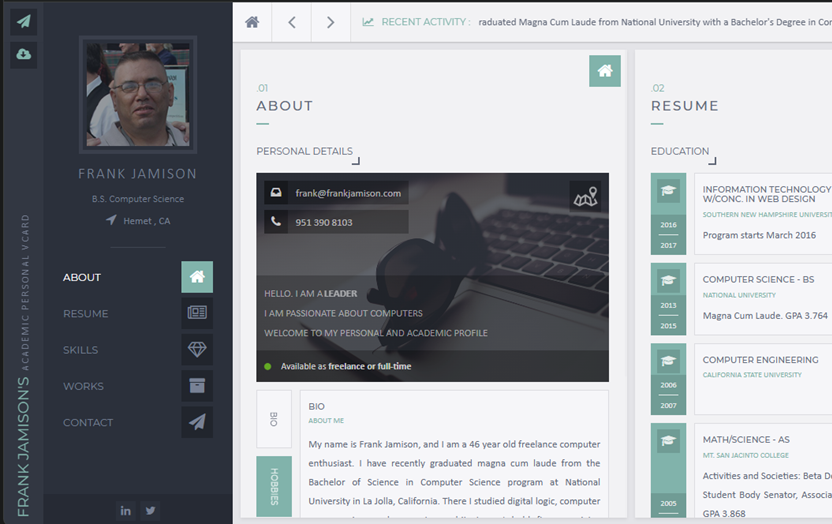
FrankJamison.com (2015)