
006
FrankJamison.com:
Practical Web Craft
There’s a certain kind of confidence that doesn’t need animation timelines or a JavaScript orchestra warming up in the background. It shows up quietly. It loads fast. It explains itself. And it keeps working six months later without a rewrite.
That’s the philosophy behind FrankJamison.com
This project is a deliberately restrained personal portfolio built with PHP, HTML, CSS, and a measured amount of JavaScript. It’s not designed to impress by excess—it’s designed to communicate clearly, behave predictably, and hold up under real-world use. Every decision favors readability, maintainability, and intent over novelty.
This isn’t a demo reel. It’s working web craft.
Design Philosophy: Clarity Before Cleverness
The design goal of this site is simple: remove friction between the reader and the information.
Recruiters should be able to scan it quickly. Developers should be able to understand its structure immediately. Employers should be able to trust that the same judgment applied here would carry over into production work.
The layout is calm and familiar, built on a Bootstrap grid but refined with custom CSS to avoid default aesthetics. Typography is readable and consistent. Spacing is intentional. Visual hierarchy does the heavy lifting so the user doesn’t have to.
There’s no novelty navigation, no hidden content, and no interaction that requires explanation. The site respects the reader’s time—and that respect is reflected in every design choice.
Front-End Structure: Straightforward on Purpose
The front end is built using semantic HTML, standard CSS, and light JavaScript enhancement. There’s no build pipeline, no bundler, and no framework abstractions masking what’s actually happening.
That’s intentional.
This approach keeps the project immediately approachable. Anyone reviewing the code can open it and understand how the site works within minutes. There’s no setup ritual and no tooling overhead obscuring the fundamentals.
Bootstrap provides layout reliability, while custom styles refine presentation. JavaScript enhances behavior where it adds value, but it never becomes a dependency for understanding or using the site.
This is front-end development as communication—not performance art.
JavaScript: Used Sparingly, Audited Carefully
JavaScript in this project exists to support the experience, not define it.
External libraries are loaded via CDNs with local fallbacks in place. This ensures the site remains functional even when third-party resources fail—an often-overlooked detail that matters in real environments.
As part of the 2026 refinement pass, unused vendored scripts were removed entirely. Every remaining script has a clear purpose. There’s no speculative code and no “we might need this later” clutter.
The result is a smaller footprint, clearer intent, and code that reflects actual requirements rather than theoretical ones.
Backend Logic: PHP That Knows Its Job
The backend is intentionally minimal, handling what it needs to handle—and nothing more.
PHP is used primarily for contact form processing, with logic that is readable, explicit, and easy to audit. There’s no framework overhead and no hidden behavior. What the code does is visible on the page.
During the 2026 update, lightweight anti-abuse protections were added to the form submission flow. These include simple timing checks, token validation, and basic rate-limiting logic to discourage automated spam without introducing unnecessary friction for real users.
This reflects a practical mindset: address the problem that exists today, and leave room to scale solutions only if and when they’re needed.
Accessibility: Built In, Not Bolted On
Accessibility is treated as a baseline expectation, not an optional feature.
The site supports keyboard navigation, maintains visible focus states, and respects reduced-motion preferences. Typography and color contrast prioritize readability across devices and conditions.
These choices don’t draw attention to themselves—and that’s the point. When accessibility is handled well, it disappears into the experience and simply makes the site work better for everyone.
SEO and Structured Data: Clear for Humans and Machines
Search optimization in this project focuses on fundamentals rather than tricks.
Content structure is semantic and consistent. Metadata is intentional. JSON-LD structured data provides clear context about the site and its owner, including identity and external references.
This isn’t about chasing algorithms. It’s about making the site legible—to search engines, assistive technologies, and future maintainers alike.
Repository Discipline: Respecting the Reviewer
One of the quiet strengths of this project is its cleanliness.
Unused files were removed. Legacy scripts were evaluated and either justified or deleted. The directory structure reflects what’s actually in use, not a history of abandoned experiments.
This matters because repositories communicate how a developer thinks. A clean codebase signals care, restraint, and respect for the next person who has to read it—whether that’s a teammate, a hiring manager, or your future self.
What This Project Demonstrates
At its core, FrankJamison.com is less about visual impact and more about professional judgment.
It demonstrates:
- Comfort with fundamentals over dependency-driven development
- Clear separation of concerns between structure, style, and behavior
- Thoughtful trade-offs instead of default complexity
- An understanding that maintainability is a feature
- Respect for users, reviewers, and future developers
This is the kind of project that doesn’t shout. It doesn’t need to. Its confidence is in how little it wastes and how clearly it communicates.
Frank's Final Thoughts
For employers and recruiters, this site shows how I approach real-world constraints: clarity over cleverness, intention over excess, and solutions that age well.
For developers, it’s an example of disciplined, readable web development that values understanding over abstraction.
And for everyone else, it simply works—quickly, quietly, and without demanding attention.
Sometimes the most professional thing you can build is something that gets out of the way and keeps doing its job.
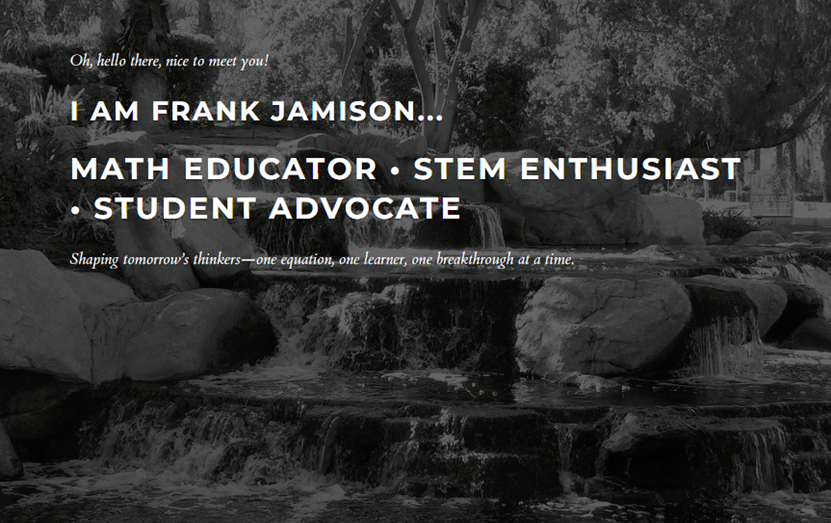
FrankJamison.com (2025)